
Paver Sealer Coverage Calculator
Pick your brand and product, enter your square footage, and get the gallons and pails you need.


Disclaimer: This calculator provides estimates only and is intended as a general guide to help determine approximate product quantities. Actual coverage will vary depending on surface type, porosity, joint width, application method, temperature, humidity and other site conditions. Always test the product on a small inconspicuous area before full application. We recommend purchasing a slightly larger quantity than estimated to account for variability. Polymeric Sand Store is not responsible for over- or under-purchasing based on these estimates. For project-specific guidance, consult the product's technical data sheet or contact the manufacturer directly.
© Polymeric Sand Store. All rights reserved.
More free hardscape calculators
Work out the rest of your order with the same approach: each manufacturer's published coverage, a 10 percent allowance, and the products ready to add to your cart.
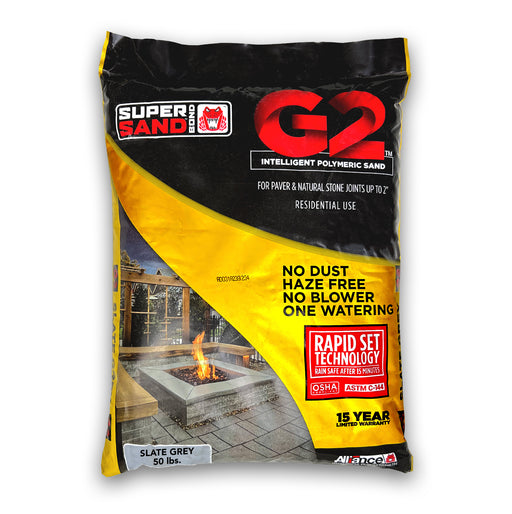 Polymeric Sand CalculatorHow many bags you need, from paver size, joint width and joint depth.Open calculator
 Resin and Permeable Joint Sand CalculatorPail counts for resin and permeable jointing sand on pavers, porcelain and stone.Open calculator
 StickyStone Adhesive CalculatorSausages or tubes of adhesive for wall caps, coping and stone veneer.Open calculator
How This Paver Sealer Calculator Works
Most sealer calculators take your square footage and divide by one average number. That is why they are so often wrong. Published coverage across the sealers on this page runs from about 75 sq ft per gallon to more than 400, a spread of five to one, and almost none of that is marketing. It comes from three things, and this calculator handles all three.
1. What the sealer actually is
A film-forming acrylic sits on top of the paver and builds a wet look or a gloss. It is applied heavier and covers less ground. A penetrating or impregnating sealer soaks into the stone and changes nothing about the appearance, so it goes much further per gallon. A joint stabilizing sealer is the thirstiest of the three, because the first coat is not just wetting the paver, it is soaking down into the jointing sand to bind it. That is why the same brand can publish 250 sq ft per gallon for one product and 100 for another.
2. How porous your surface is
On the products where coverage is porosity-dependent, this calculator asks you to describe the surface, because a rough tumbled paver or an older unsealed patio can absorb close to twice what a smooth, dense, recently laid paver does. If you are unsure, choose the more porous option. Running short in the middle of a patio is a far worse problem than having a part gallon left over.
3. Fixed-rate products
Some sealers publish a single rate regardless of surface, usually because the manufacturer specifies a set film thickness rather than a saturation coat. For those the calculator uses the published figure directly rather than pretending porosity changes it.
Why we add 10 percent
The recommendation always carries about 10 percent over the raw calculation. That covers overlap on the second pass, what stays in the tray and the roller, the edge you go back over, and the fact that no patio is a perfect rectangle. Sealer that is left sealed and stored somewhere frost-free keeps for the next job; a job that stops three quarters of the way across a driveway leaves a visible line you cannot blend out later.
A note on published figures
Every number here comes from the manufacturer technical data sheet for that specific product, per coat. If a sealer needs two coats, the calculator sizes the coats you tell it about. Always check the label for your batch, because manufacturers do revise these rates, and confirm the surface is clean, dry and cured before you start.
Paver Sealer Coverage Questions and Answers
Coverage is the single biggest variable in a paver sealing job, and it is where most people over-order or come up short. These are the questions we get asked most often about how much sealer a project actually takes.
How much paver sealer do I need per square foot?
Divide your square footage by the coverage rate published for your specific product. Most paver sealers land somewhere between 80 and 200 square feet per gallon per coat, so a 500 sq ft patio typically needs 3 to 6 gallons for a single coat. The calculator above uses each manufacturer's own published rate rather than a generic average, which is why the answer changes when you switch products.
How many square feet does a gallon of paver sealer cover?
It depends on the sealer type and how thirsty the surface is. Penetrating sealers on dense, smooth concrete pavers reach the high end of their range. Film forming wet look sealers, joint stabilizing sealers, and anything applied over rough, porous or weathered pavers use noticeably more. Work from the coverage rate on the product's technical data sheet and treat any single number quoted online as a best case figure.
Why does coverage change so much between sealers?
Three things drive it: solids content, whether the sealer sits on the surface or soaks into it, and whether it also has to fill joints. A high solids wet look sealer lays down a thicker film and covers less area per gallon. A joint stabilizing sealer has to saturate the sand between the pavers as well as coat the surface, so a meaningful share of every gallon disappears into the joints.
Do I need one coat or two?
Most film forming wet look and gloss sealers are specified as two coats, and the second coat is usually what produces the finish you bought the product for. Many penetrating sealers are a single saturating application. Skipping the second coat on a two coat product is the most common reason a sealed patio ends up looking patchy. Check the data sheet before you order, and if it calls for two coats, double the gallons the calculator gives you for one.
Does a rough or porous surface really use more sealer?
Yes, and by more than most people expect. Tumbled, textured, weathered or older pavers can consume 30 to 50 percent more product than a smooth, dense, newly laid surface. Natural stone is thirstier still, particularly unsealed flagstone and travertine. The calculator asks about surface porosity for exactly this reason.
How much sealer do I need for a 500 square foot patio?
At 150 sq ft per gallon, one coat needs about 3.5 gallons, so you would buy a 5 gallon pail. At 100 sq ft per gallon over two coats you are at 10 gallons. That spread is why the question has no single answer, and why it is worth selecting your actual product in the calculator above rather than working from a rule of thumb.
What is the difference between water based and solvent based paver sealers?
Solvent based sealers generally penetrate more aggressively, produce a stronger wet look, and tolerate cooler application temperatures. Water based sealers have lower odor and lower VOC content, clean up with water, and are required or preferred in some states. Coverage rates differ between the two even within the same product family, so do not assume the water based version of a sealer covers the same area as its solvent based counterpart.
Do joint stabilizing sealers use more product?
They do. A joint stabilizing sealer has to soak into the jointing sand deeply enough to lock it in place, and wide or deep joints absorb a great deal of material. If your joints are wider than about half an inch, plan on the high end of the product's range or above it. This is one job where ordering an extra pail is far cheaper than running out partway through.
Should I order extra sealer?
The calculator already adds a 10 percent buffer, which covers normal variation on a straightforward job. Add more on top of that if your pavers are old or porous, your joints are wide, the surface has never been sealed, or the area has a lot of edges and curves where product gets lost. Running out in the middle of a coat leaves a visible lap line that is difficult to correct afterwards.
Can I keep leftover paver sealer for next year?
Usually yes, if the container is resealed tightly and stored somewhere that does not freeze. Water based sealers are ruined by freezing. Solvent based sealers tolerate cold better but must be kept away from heat and ignition sources. Check the shelf life on the technical data sheet, and stir rather than shake before reusing.
How long before I can walk or drive on sealed pavers?
This varies by product, temperature and humidity, so the technical data sheet is the only reliable source. As a general shape, light foot traffic tends to be allowed within several hours to a day, and vehicle traffic considerably later. Cool or humid weather extends both. Do not move patio furniture back before the sealer has fully cured, because feet and pads will mark a film that is still soft.
Do I need to wait before sealing brand new pavers?
Most manufacturers ask you to wait so efflorescence can work its way out of the new concrete first, commonly somewhere in the range of 30 to 90 days. Sealing over efflorescence can lock a white haze permanently under the film. The exact waiting period is specified on each product's data sheet.
What happens if I apply too much sealer?
Over application is the most common paver sealing failure. On film forming sealers it shows up as a white blush or haze, a tacky surface that stays soft, bubbling, or a plastic looking sheen. Sealer that pools in low spots dries differently to sealer on high spots, which is what produces a blotchy finish. Two thin coats always beat one heavy one.
Should I seal before or after polymeric sand?
After. Install and fully activate the polymeric sand first, let it cure for the period the sand manufacturer specifies, then seal. Sealing first prevents the sand from bonding properly to the paver edges. If you are working out sand quantities as well, use the polymeric sand calculator for that side of the job.
- Technical data sheets and safety data sheets for every sealer we carry, with the manufacturer coverage rates this calculator uses.
- Polymeric sand calculator for working out bag counts on the jointing side of the job.
- Shop paver sealers across Alliance Gator, Techniseal, SEK Surebond and SRW.
- Paver sealer samples if you want to test the finish on your own pavers before committing to a full pail.